WAR ,WEAPONS AND INTERNATIONAL AFFAIRS.

Authors required to post topics in this blog. those interested mail at jawad95@gmail.com

Search This Blog

Showing posts with label russian navy. Show all posts

Wednesday, August 5, 2009

U.S. eyes Russian submarines off East Coast


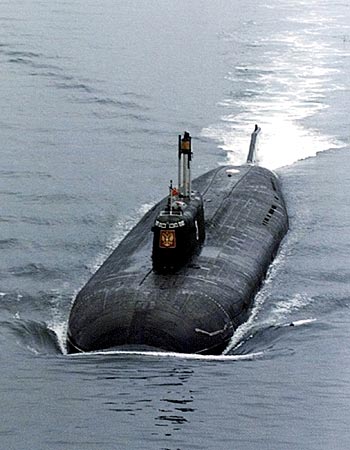
WASHINGTON (CNN) -- Two Russian attack submarines have been cruising in the Atlantic off the East Coast of the United States, a senior defense official said Wednesday.

Russian attack submarines such as this one have been spotted in the Atlantic Ocean.
Pentagon spokesman Geoff Morrell said their presence is not causing alarms to go off.
"So long as they are operating in international waters, as, frankly, we do around the world, and are behaving in a responsible way, they are certainly free to do so, and it doesn't cause any alarm within this building," he said.
It has been years since Russia operated near the U.S. seaboard, thousands of miles from home ports.
"What's interesting is, they haven't been able to do this in some time, and now they are. It indicates a return to their ability to do this," the senior defense official said.
He viewed the patrol as an example of Russia showing the United States and the world its expeditionary forces, part of a continuing trend. He said the Russians have recently been a partner in anti-piracy operations around the world. And last year the Russian Navy conducted a "tour around the world," pulling into ports throughout Latin America.
In December, a Russian spokesman said that tour demonstrated "Russia's ability to fly its naval flag and ensure protection of its national interests in the world theater."
The Akula-class nuclear-powered submarines, which are normally equipped with surface-loaded cruise missiles and surface-to-air missiles, have stayed in international waters, the source said. These are not the class of submarines that can launch intercontinental nuclear missiles.
The U.S. Navy has the capability to locate, identify and track submarine activity through satellites, ships, aircraft and classified systems.
"NORAD and U.S. Northern Command are aware of Russian submarine activity off the East Coast operating in international waters. We have been monitoring them during transit and recognize the right of all nations to exercise freedom of navigation in international waters according to international law," said Lt. Desmond James of the North American Aerospace Defense Command.
A Russian military spokesman said at a news conference in Moscow that the submarines' activities were "part of the normal process."
Defense officials told The New York Times that one of the Russian submarines was in international waters Tuesday about 200 miles off the coast of the United States. The location of the second was unclear.
U.S. officials downplayed the significance of the submarines operating off the U.S. coast.
"There is no need to overreact," the senior defense official said.
"This is not an issue of concern. It is all consistent with the internationally-recognized principle of freedom of navigation. As long as the vessels do not cross into territorial waters, they are free to navigate any open waters," another official said.
Officials have said this is the naval equivalent to Russian bomber missions close to U.S. and other countries' borders.
"It is Russia again trying to assert its influence and trying to show they have a relevant military," a third defense official sai

Reblog this post [with Zemanta]

Sunday, August 2, 2009

RUSSIAN NAVAL DREAMS SINKING….


Last year, Russian admirals were talking about building half a dozen carriers, and escort ships. That was when oil (major export) was at over a hundred dollars a barrel. Now there’s a global recession, and all raw materials prices are down. Moreover, the admirals have come to realize that their nuclear submarine program is in big trouble. The submarine construction industry, which used to turn out several nuclear subs a year, has been producing less than one a year since the early 1990s, and cannot build new boats fast enough to replace those that have to be retired.

The Russian Navy has not only shrunk since the end of the Cold War in 1991, but it has also become much less active. In the last three years, only ten of their nuclear subs went to sea, on a combat patrol, each year. Most of the boats going to sea were SSNs (attack subs), the minority were SSBNs . There were more short range training missions, which often lasted a few days, or just a few hours. But the true measure of a fleet is the “combat patrol” or “deployment.” In the U.S. Navy, most of these last from 2-6 months. In the last three years, U.S. nuclear subs have carried out ten times as many patrols as their Russian counterparts.

Currently, Russia only has 14 SSBN (nuclear ballistic missile sub) boats in service, and not all of them have a full load of missiles. Some lack full crews, or have key systems in need of repair. Only eight of these SSBNs can actually go to sea. Russia has only 14 modern, 7,000 ton, Akula SSNs (nuclear attack subs) in service. These began building in the late 1980s and are roughly comparable to the American Los Angeles class. All of the earlier Russian SSNs are trash, and most have been decommissioned. There are also eight SSGN (nuclear subs carrying cruise missiles) and 20 diesel electric boats. There is a new class of SSGNs under construction, but progress, and promised funding increases, have been slow.

The peak year for Russian nuclear sub patrols was 1984, when there were 230. That number rapidly declined until, in 2002, there were none. Since the late 1990s, the Russian navy has been hustling to try and reverse this decline. But the navy budget, despite recent increases, is not large enough to build new ships to replace the current Cold War era fleet that is falling apart. The rapid decline of Russia’s nuclear submarine fleet needed international help to safely decommission over a hundred obsolete or worn out nuclear subs. This effort has been going on for nearly a decade, and was driven by the Russian threat to just sink their older nuclear subs in the Arctic ocean. That might work with conventional ships, but there was an international uproar over what would happen with all those nuclear reactors sitting on the ocean floor forever. Russia generously offered to accept donations to fund a dismantling program that included safe disposal (of the nuclear reactors).

Since the end of the Cold War in 1991, most of the ship building money has gone into new nuclear subs. Six Akulas have been completed in that time, but all of these were under construction when the Soviet Union dissolved in 1991. Since 1991, only one nuclear sub has been laid down, and completed. The first of a new generation of SSBNs, the Borei class has been delayed by technical problems, a new ballistic missile that wouldn’t work, and lack of money. The first Borei class boat, after many delays, is finally ready for service, but ended up costing over two billion dollars.

The Russian admirals made their big mistake in the early 1990s, when the dismantling of the Soviet Union left the second largest fleet in the world with only a fraction of its Cold War budget. Rather than immediately retire ninety percent of those ships, Russia tried to keep many of them operational. This consumed most of the navy budget, and didn’t work. There were too many ships, not enough sailors and not enough money for maintenance or training at sea. The mighty Soviet fleet is mostly scrap now, or rusting hulks tied up at crumbling, out-of-the way naval bases.

While Western nuclear subs can last for about thirty years, Russian models rarely get past twenty. That means two new SSN or SSGN has to be put into service each year to maintain a force of forty boats. Unless the sub construction budget get billions more dollars a year, that is not going to happen. Right now, the priority is on producing a new class of SSBNs (11 more Boreis are planned or under construction). These Boreis are critical, because they carry SLBM (Sea Launched Ballistic Missiles) that provide a critical (they are much harder to destroy in a first strike than land based missiles) portion of the nuclear deterrent. The rest of the Russian armed forces, like most of the navy, is in sad shape, and unable to resist a major invasion. Only the ICBMs and SLBMs guarantee the safety of the state. So the way things are going now, in a decade or two, Russia will end up with a force consisting of a dozen SSNs and a dozen SSBNs. And no aircraft carriers